FAQ

How can we help you?

THE PROJECT

The project is located at Captains Mountain in the Toowoomba Region of Queensland, approximately 15km southwest of Millmerran and 80km southwest of Toowoomba. The Millmerran Power Station is nearby the proposed development area, and the project is accessible via the Gore Highway.

The project will consist of approximately 35 turbine locations with a combined maximum capacity of around 250MW. The project may be built in one or more stages.

The project will be permitting Vestas V172-7.2 MW or larger turbines. These turbines will have a hub height of around 166m and a maximum blade tip height of up to 252 m.

The project will be assessed under Queensland’s Planning Act 2016 and requires a development application to be lodged with the State Assessment and Referral Agency (SARA). Recent changes to the assessment framework mean all wind farm applications submitted from 3 February 2025 onwards are subject to an impact assessment, requiring more comprehensive reporting, broader impact considerations, and increased community consultation.


A qualified independent consultant supports preparation of the development application, which will be assessed against relevant state planning provisions.


Additionally, the project will be referred to the Australian Government Department of Climate Change, Energy, the Environment and Water (DCCEEW) for assessment under the Environment Protection and Biodiversity Conservation (EPBC) Act, if required.

We are committed to ongoing community engagement throughout all stages of the wind farm’s lifecycle, from site selection through to decommissioning.


As part of the planning approvals process, there will be formal periods for public comment, allowing community members to review and provide feedback on the project. These opportunities will be advertised through relevant government channels and our own communication platforms.


Beyond these formal consultation periods, we will continue to engage with all levels of government, landowners, nearby residents, Indigenous communities, local businesses, and the wider community to keep everyone informed and involved where possible.

WIND ENERGY

Climate change is pushing Australia and the rest of the world to move away from fossil fuels towards cleaner sources of energy. Wind energy is a clean and inexhaustible resource that does not produce any pollution or emissions during operation.


Wind energy is now more cost-effective than new energy generation from coal and natural gas. In combination with other renewable energy projects like solar, wind energy is helping to lower the overall cost of electricity.


As of year end 2021, there was more than 9,100 MW of wind capacity installed across Australia. Wind farms accounted for nearly 12% of the total electricity generated in the country in 2021.

Compared to traditional energy sources such as coal and gas, wind farms:

  • require no invasive mining, extraction or burning of fossil fuels
  • emit no greenhouse gas during operations
  • emit no fine particle pollution, sulphur dioxide, or oxides of nitrogen
  • require no water during operation
  • have limited environmental impacts from construction.

All emissions generated across the turbine lifecycle are offset in the first year of plant operation.

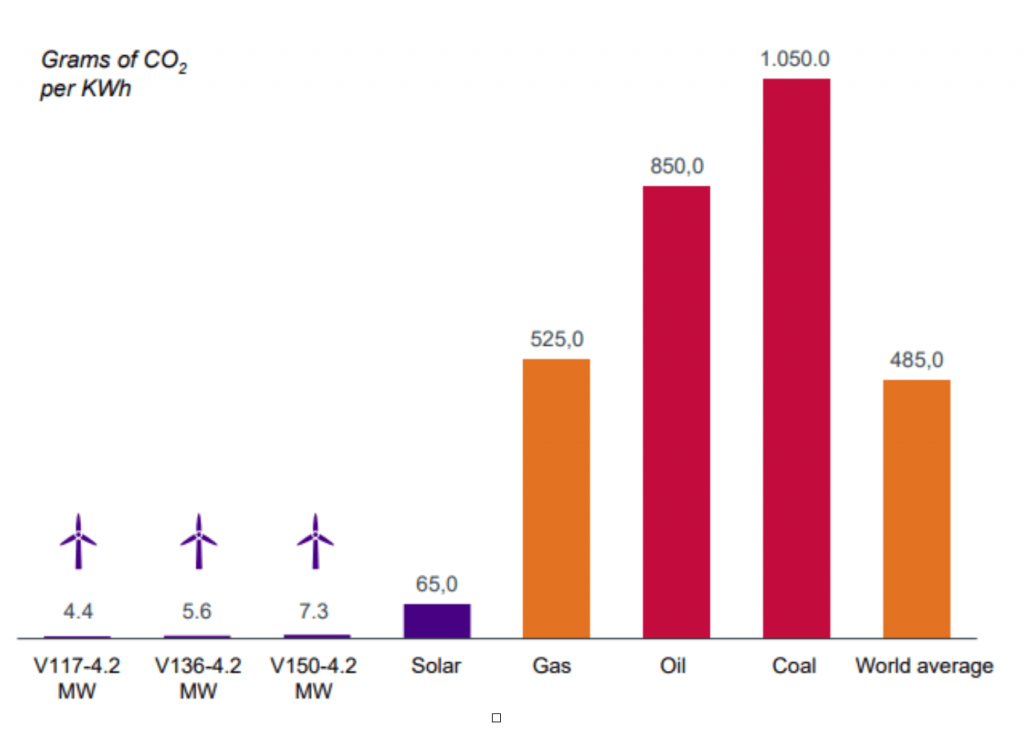
Wind farms have significantly reduced carbon footprints compared to other electricity-generating sources. A typical Vestas wind turbine only emits around 1% of the carbon emissions per kWh of electricity that would be generated by a coal-fired power plant.
 

Captains Mountain Wind Farm

Wind turbines convert the natural movement of air into mechanical energy through rotation of the turbine blades. This mechanical energy is converted into electricity, which is sent to the electrical grid.

The Captains Mountain Wind Farm will be built using Vestas wind turbines. More than 160,000 MW of Vestas turbines have been installed in 88 countries around the world, accounting for almost 1 in 5 of all turbines installed worldwide.

Wind farms are considered to be one of the cheapest forms of new electricity generation, along with solar energy, and can produce energy at a significantly lower cost than fossil fuel generation. The project is not dependent on government subsidies for construction or operation.

PROJECT IMPACTS

Several studies have examined the potential impacts of wind farms on property values, including Review of the Impact of Wind Farms on Property Values (Urbis, 2016) available here, and Assessment of the Impact of Wind Farms on Surrounding Land Values in Australia (Preston Rowe Paterson, 2013) available here.

These studies have found no evidence to conclude that wind farms can be linked to adverse impacts on property values.

Most wind farms are developed on farmland, and the presence of wind turbines is often compatible with existing farming activities. The turbines only take up a small amount of land, and landowners can continue to graze their livestock or grow crops as usual. In fact, animals have been observed using the towers for shelter from the sun and inclement weather. Additionally, the income provided to landowners hosting wind farm infrastructure can help their business become more resilient to the impacts of droughts, fires and commodity price fluctuations.

Captains Mountain Wind Farm will seek to minimise the impact to local flora and fauna by designing the project to avoid areas of high conservation significance. Additionally, we will adopt best practice control measures to minimise impacts to biodiversity during construction.


As part of project development, we will engage specialist consultants to undertake detailed flora and fauna surveys of the site. Both desktop and field surveys will be conducted to establish the ecological attributes of the land. Field surveys will be conducted across wet and dry seasons.


The results of the surveys and proposed mitigation measures will be documented in the project’s Development Application and will be assessed by the QLD State Assessment and Referral Agency as part of the project’s development consent.

We are consulting with local Aboriginal groups and other local stakeholders during project development and design. Vestas will also engage a specialist consultant to assess potential impacts related to cultural heritage and how to mitigate these impacts. At all times, the project will be developed in compliance with laws regarding the protection of cultural heritage.

The project will deliver significant benefits to the Millmerran region and surrounding communities, including:

  • Major investment in the local economy
  • Opportunities for local contractors, suppliers, and businesses
  • Up to 275 jobs at peak during construction, with an average of 140 FTE over the period
  • Around 10 long-term jobs in service and maintenance once operational
  • Development of new skilled labour in the growing renewable energy sector

As the project progresses, Vestas will engage with local stakeholders to help shape a community benefit fund that responds to local needs and priorities.

The project is expected to create up to 275 jobs at peak during construction, with an average of around 140 full-time equivalent (FTE) roles over the construction period.


Once operational, the project will support around 10 long-term jobs in service and maintenance.

Jobs will span a wide range of skill areas including engineering, electrical and mechanical trades, construction, transport, equipment operation, building materials, consulting, and administration.

Captains Mountain Wind Farm plans to work in partnership with the local community to design a community benefits fund that delivers tangible and positive results. This scheme is intended to last for the life of the project. Further details will be provided as the project develops.

PROJECT CONSTRUCTION

We expect to begin construction in 2027, subject to development consent and grid connection approval. Construction will take approximately 2-3 years to complete.

We understand that water is a critically important issue for the Millmerran community. During construction, water will be required for concrete batching and potentially for dust suppression. Vestas will source water from local supplies, subject to availability and within the constraints of the development consent for the project.


Once the wind farm is constructed, water will only be required to meet domestic/personal requirements for maintenance staff.

Recognising the significance of water for the Millmerran community, Captains Mountain Wind Farm will source water from local suppliers for concrete batching and dust suppression during construction, provided that it is available and within the constraints of the project's development consent. After the wind farm is constructed, water will only be required for the everyday needs of maintenance personnel.

As part of project development, we will assess local and regional roads to identify a suitable transport route to the project site.

At this stage, we expect wind turbine components will be transported from the Port of Brisbane to Toowoomba via the Warrego Highway (National Highway A2), and then to the project site via the Gore Highway (National Highway A39).


We will engage with council, local stakeholders, and the broader community to seek feedback on the proposed route. The final transport route — including any required road upgrades — will be outlined in the Development Application.

PROJECT OPERATIONS

Many reviews of research literature conducted by leading health and research organisations worldwide, including Australia’s National Health and Medical Research Council (NHMRC), have concluded there is no published evidence to link wind turbines with adverse health effects.


Overall, it is important to note that while more research is needed to fully understand any potential health impacts of wind farms, many studies have found that wind farm noise is generally at levels that are unlikely to cause health problems.

Wind turbine movement creates sound; however, people generally find they can have a conversation at the wind turbine base without having to raise their voices. The noise impact from a wind turbine will depend on wind speed, wind direction, topography, vegetation, and the distance from the turbine

PROJECT DECOMMISSIONING

The wind farm will have a design life of 30 years. At the end of this period, it may be possible to replace some equipment and extend the project for a further operating period, though this would require a new development approval. 

At the end of its operational life, the wind farm will be deconstructed in accordance with the Queensland Wind Farm State Code and supporting planning guideline. In addition, contracts with landowners require that wind turbines and other infrastructure are removed at the end of the lease term.


Decommissioning will involve de-energising, disconnecting, dismantling, demolishing and removing the wind turbines and other operational infrastructure (e.g. maintenance buildings, substations and power lines). We will also rehabilitate roads and fencing in consultation with host landowners.

Decommissioning is an obligation under the Project's development consent. Current approvals mandate an End of Construction Decommissioning Management Plan before construction ends and an End of Operation Decommissioning Plan before shutting down operations. Decommissioning involves de-energising, disconnecting, and removing wind turbines and related infrastructure, such as substations.

Currently, Vestas wind turbines are 85% recyclable, though rotor blades still contain non-recyclable composite materials. Vestas aims to achieve 100% recyclable rotors by 2030, ensuring materials can be reused in new turbines or similar applications. Additionally, advancements in "re-powering" allow for replacing or upgrading critical components, extending wind farm lifespans beyond 30–35 years, reducing impacts while ensuring continued energy generation.

Contact Us

We're here to answer questions, provide updates and receive your feedback